In House vs Studio Production for B2B Video
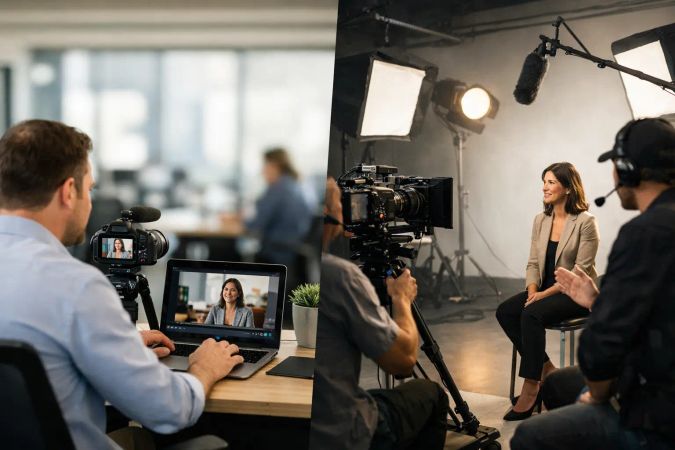
A lot of B2B teams buy cameras before they answer the harder question: what exactly are we building, and who needs to trust us when they see it? That is where the real in house vs studio production decision starts. It is not just about gear or aesthetics. It is about whether your video process can consistently produce content that strengthens authority, supports search visibility, and helps turn expertise into pipeline.
For professional services, logistics firms, legal teams, finance companies, and other trust-driven businesses, video is rarely just a brand exercise. It has to do more. It has to explain, reassure, differentiate, and stay usable across multiple channels. That is why the production model matters more than many teams expect.
In house vs studio production is really a strategy choice
On paper, in-house production sounds efficient. Your team controls the schedule, can record quickly, and does not need to book outside time every time an idea comes up. For companies producing frequent updates, internal training, recruiting videos, or quick social clips, that flexibility can be a real advantage.
But studio production solves a different problem. It reduces inconsistency. It creates an environment where lighting, sound, framing, pacing, and on-camera coaching are managed by people who do this every day. For businesses trying to build executive credibility or launch a video podcast that supports thought leadership, that difference shows up fast.
The key issue is not whether one option is universally better. It is whether your current content demands repeatable quality, stronger messaging discipline, and fewer production bottlenecks.
Where in-house production makes sense
If your business already has a capable marketing team, an internal content lead, and someone who can reliably shoot and edit, in-house can be a smart model. It works best when volume matters more than polish and when the content format is straightforward.
A company recording weekly internal updates or quick product explainers may not need a dedicated studio every time. In-house setups can also work well when subject matter experts are available for short windows and the team needs to capture ideas on the fly.
There is also a cost argument, at least initially. Once equipment is purchased, internal production can seem less expensive per video. For organizations with enough content demand, that math can be attractive.
Still, there is a hidden operational cost. Internal teams often become the default production crew without having the time, systems, or editorial distance to do it well. The marketer becomes the camera operator. The operations manager helps with audio. The executive records between meetings. The result is usually content that gets made, but not always content that performs.
That gap matters when the goal is lead generation, search visibility, or premium brand perception.
Where studio production creates better business value
Studio production is usually the stronger choice when the content needs to represent your company at a high level, especially in fields where trust is earned through clarity and professionalism. If a managing partner, founder, broker, advisor, or executive team is going on camera, the setting and execution influence how the message lands.
A strong studio process improves more than visual quality. It shapes delivery. It shortens setup time on recording day. It gives your team a controlled environment that avoids office noise, bad lighting, inconsistent framing, and technical distractions. More important, it lets leadership stay focused on the message instead of managing production details.
This is especially valuable for video podcast marketing. A podcast is not just a single asset. It is a content engine. One recording session can fuel full episodes, short clips, quote graphics, email content, and search-oriented video pages. But that only works if the footage is clean, the audio is credible, and the conversation is structured well enough to be repurposed.
When businesses try to build a podcast internally without a production system, the effort often stalls. Episodes become irregular. Quality shifts from week to week. Editing takes too long. Guests have uneven experiences. Momentum drops. A studio partner helps protect consistency, which is what turns a podcast from a side project into a discoverability asset.
The real tradeoffs in in house vs studio production
Cost is usually the first concern, but it should not be the only one. A cheaper production model that produces inconsistent content, delays publishing, or weakens trust can become expensive in ways that are harder to track.
In-house production gives you access and flexibility. Studio production gives you reliability and market-facing quality. One is not automatically more strategic than the other. It depends on what failure would cost you.
If a missed internal update is no big deal, in-house is fine. If a poor-looking client-facing video makes your firm appear less established than it is, the stakes are different.
There is also the issue of executive time. Senior leaders are expensive participants in the content process. If they spend 45 minutes troubleshooting a mic, waiting for a room to open up, or re-recording because the footage was not usable, the company is not saving money. It is shifting cost into the least efficient part of the workflow.
Studio production often looks more expensive on a line item basis, but it can lower total friction. That matters when your team wants recurring branded content, authority-building interviews, and searchable media that supports actual revenue goals.
How to decide what fits your business
The best way to evaluate in house vs studio production is to start with the role video plays in your growth strategy.
If video is mainly supporting communication, culture, or quick promotional moments, in-house may be enough. If video is expected to build authority, improve search performance, support sales conversations, and generate consistent audience trust, studio production usually delivers stronger returns.
Ask a few practical questions. Does your team have the internal discipline to publish on a schedule? Can you maintain consistent audio and visual quality across months, not just one shoot? Do your subject matter experts feel comfortable on camera without coaching? Can your team transform one recording session into multiple useful assets?
Most businesses answer yes to one or two of those questions, not all of them. That is where an outside studio model becomes useful - not because the company lacks expertise, but because its expertise is in law, finance, real estate, logistics, or technology, not content operations.
For many firms, the strongest answer is a hybrid approach. Simple internal updates can stay in-house. High-value thought leadership, video podcasts, client-facing brand pieces, and cornerstone content can be produced in a studio environment. That structure protects efficiency without lowering the quality of your most visible assets.
Why this matters for search, trust, and lead generation
Search behavior is changing, but one thing remains constant: businesses that publish useful, credible content earn more attention over time. Video now plays a bigger role in that process because it keeps audiences engaged longer and gives subject matter experts a more persuasive format than text alone.
That is one reason video podcast marketing has become so effective for B2B brands. It lets your team show how it thinks, not just what it sells. For a CPA firm, attorney, commercial broker, or logistics provider, that matters. Buyers want evidence of judgment. They want to hear expertise explained clearly. A polished, repeatable studio setup helps your business package that expertise in a way people actually trust.
For companies in competitive markets like South Bay Los Angeles and the Harbor area, where reputation and referrals still matter but digital discoverability matters more every year, the production standard of your content can either reinforce your authority or quietly undercut it.
A studio partner like Voxel Micro Video Labs is valuable when you need more than content that looks good. You need content that carries business weight - assets that support visibility, credibility, and sales conversations over time.
The better question is not which is cheaper
The better question is which model helps you publish consistently, present your expertise credibly, and turn recorded knowledge into marketing assets that keep working after the camera is off.
That answer will not be identical for every business. But if your video needs to build trust before a prospect ever speaks with your team, production is not a background decision. It is part of the strategy.
Choose the model that makes your expertise easier to believe, easier to find, and easier to act on.