South Bay Business Video Studio That Performs
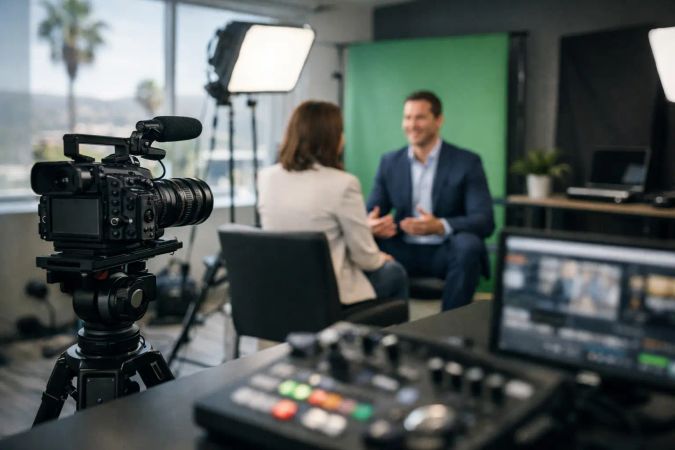
A polished set, good lighting, and clean audio are table stakes. If you are evaluating a South Bay business video studio, the real question is whether the content will move the business forward after the cameras stop rolling. For professional service firms, B2B companies, and expert-led organizations, video needs to do more than look credible. It needs to create discoverable assets, strengthen authority, and give your team usable content across search, sales, and client nurturing.
That changes how a business should think about a studio.
What a South Bay business video studio should actually deliver
Many studios are built around production quality alone. That matters, but it is only part of the job. Business video has a different standard than entertainment or lifestyle content. The audience is often evaluating expertise, reliability, and fit before they ever reach out. A law firm, accounting practice, logistics company, commercial real estate group, or technology provider is not just buying visuals. They are shaping market perception.
A strong studio partner helps translate subject-matter expertise into media that feels clear, credible, and consistent. That means the work starts before filming. It includes message framing, episode or topic planning, audience alignment, and an understanding of how the content will be distributed later.
This is especially relevant in the South Bay and Harbor Area, where many organizations operate in relationship-driven industries. Buyers are not looking for flashy content. They are looking for confidence signals. A well-produced business video or video podcast can become one of the clearest signals you have.
Why video podcasting fits serious industries
Video podcasting works particularly well for firms that have deep expertise but limited time to create content from scratch every week. Instead of producing disconnected social clips or one-off promotional videos, a recurring video podcast creates a repeatable system. One recording session can generate a long-form episode, short clips, quote graphics, topic-based snippets, website content support, and sales-enablement media.
For executive teams and marketers, the appeal is not novelty. It is efficiency.
A good video podcast also creates a more believable kind of authority. When prospects can watch a managing partner explain market shifts, hear a logistics executive break down supply chain realities, or listen to a tax advisor answer common questions in plain language, trust builds faster. The format gives expertise room to breathe. That is hard to achieve in a single brochure page or a generic ad campaign.
There is a trade-off, though. Video podcasting only works if the conversation has structure. Casual conversation without a clear business purpose tends to create volume without value. The strongest studio process keeps the discussion natural while guiding it toward topics your audience is already searching for, asking about, or struggling to understand.
Production quality matters, but strategy matters more
Businesses often compare studios by camera packages, set design, and pricing. Those factors count, but they do not tell you whether the content will perform. The better comparison is strategic capability.
Can the studio help your team choose topics that support your positioning? Can it shape episodes around actual buyer concerns? Can it produce a body of content that stays useful after the first week of posting? Can it help your executives look confident on camera without sounding scripted?
A business-first studio should be able to answer yes to all of that.
This is where many companies either overbuy or underbuy. Some spend heavily on high-end production that has no distribution logic behind it. Others choose the cheapest option and end up with content that feels flat, generic, or off-brand. The right middle ground is production designed around outcomes: credibility, discoverability, consistency, and reuse.
The best studio content starts with business intent
Not every video should do the same job.
Some content should build top-of-funnel visibility by answering common market questions. Some should deepen trust with prospects who are already comparing providers. Some should reinforce brand positioning by showing how your team thinks, not just what you sell. A smart production plan accounts for those different roles.
For example, a commercial real estate firm may need market commentary, client education, and executive perspective. A legal practice may need issue-based explainers, credibility-building interviews, and thought leadership around industry changes. A shipping or logistics company may benefit from content that clarifies operational complexity and demonstrates command of the market. The format can look similar, but the messaging should not.
That is why a studio built for business use has more value than a generic rental space. It should understand how to turn expertise into a content engine, not just a shoot day.
Search value is now part of the production brief
The old model treated video as a brand asset and search as a separate channel. That line is getting thinner.
Today, content needs to support visibility across traditional search and AI-driven discovery. That means the substance of the conversation matters. If your videos consistently address the questions, concerns, and topics your buyers care about, they become more than media. They become discoverability assets.
This does not mean every episode needs to sound like keyword stuffing. It means the studio and content team should know how to frame topics in ways that match real search behavior while preserving a professional tone. The best business video feels natural on camera and still aligns with how people research services.
That is particularly useful for firms with specialized knowledge. Accountants, attorneys, consultants, brokers, and technical operators often sit on highly valuable insights, but those insights rarely become searchable content unless someone structures the process. A strategically run studio fixes that gap.
What to look for in a South Bay business video studio
If you are choosing a studio partner, look past the highlight reel. Ask how the process supports recurring content and actual business use.
A studio should make it easier for your experts to show up consistently. That includes a professional environment, dependable audio and visual standards, and a workflow that reduces friction for busy teams. But it should also include editorial direction. Without that, recurring production can start strong and lose momentum quickly.
You should also consider whether the studio understands your industry. Professional services and B2B sectors need nuance. Compliance concerns, reputation sensitivity, technical subject matter, and long sales cycles all affect what good content looks like. A studio that understands those realities will ask better questions and capture more useful material.
Geography can matter here too. For companies based in South Bay Los Angeles, San Pedro, Torrance, El Segundo, or Long Beach, local access is practical. It shortens the distance between planning and execution. Teams are more likely to record consistently when the process feels operationally easy, not like a full-day production event every time.
Why recurring studio sessions outperform one-off shoots
One-off videos can be effective for a launch, announcement, or brand overview. But most businesses do not have a visibility problem because they lack one nice video. They have a consistency problem.
Recurring studio sessions create pattern, and pattern builds momentum. Your audience starts seeing your team as present, informed, and active in the market. Your website gains a growing library of relevant media. Your marketing team has more raw material to work with. Your sales team has better follow-up assets. Over time, the compounding effect is what matters.
This is one of the strongest cases for video podcast marketing. It gives structure to consistency. Rather than asking your team to invent new content formats every month, it creates a repeatable production model around conversations you are already qualified to lead.
At Voxel Micro Video Labs, that business case is the point. Studio production works best when it is tied to amplification, authority, and search-oriented content planning, not just aesthetics.
The right studio partner should make experts easier to trust
Most business leaders do not need help having expertise. They need help presenting it clearly.
That is the practical value of a business-focused studio. It reduces the gap between what your team knows and what your market can actually see. With the right setup, your expertise becomes more accessible, more consistent, and more useful to the people evaluating your firm.
Not every company needs the same production cadence, format mix, or content depth. A founder-led advisory firm may benefit from straightforward interview episodes. A larger organization may need multi-speaker podcast production, branded educational segments, and a long-term content calendar. It depends on internal bandwidth, audience expectations, and sales complexity.
What does not change is this: video performs best when it is built as a system rather than a standalone creative project. If your next studio session can help your brand rank, inform, reassure, and convert, it stops being content for content's sake. It becomes infrastructure for growth.
The smartest move is to choose a studio that understands that distinction from the start.