Torrance Podcast Recording Studio for Brands
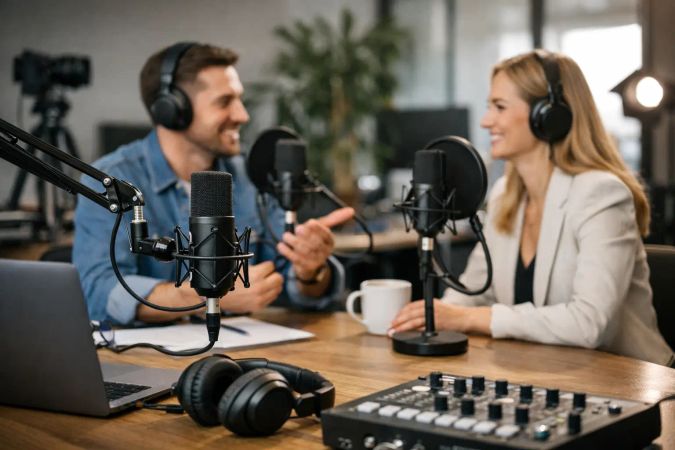
A founder sits down to record a podcast episode, shares 20 years of expertise in commercial real estate, tax strategy, legal risk, or logistics, and then the conversation disappears after a few social clips. That is usually the real problem. A Torrance podcast recording studio should not just help you capture content. It should help you turn expertise into a repeatable marketing asset that supports visibility, trust, and pipeline growth.
For serious businesses, podcasting works best when it is treated as structured brand media, not casual content. The production quality matters, but the business value matters more. If your team is investing time to show up on camera, the output should support search performance, thought leadership, audience trust, and lead generation.
What a Torrance podcast recording studio should actually do
Many companies start by searching for a studio because they need microphones, cameras, lighting, and a quiet room. Those basics matter. Bad audio weakens credibility fast, and poor lighting makes even strong speakers look unprepared. But for a business podcast, the studio choice should go beyond equipment.
The right Torrance podcast recording studio helps shape a format that fits your market. A law firm may need an interview structure that highlights subject-matter authority without sounding stiff. A logistics company may need episodes that make complex supply chain topics more understandable for customers and partners. A professional services brand may need content that feels polished, credible, and easy to repurpose across web, email, sales, and social channels.
That is the difference between recording content and producing business media. One gives you files. The other gives you usable assets.
Why video podcasting works for business brands
For B2B companies and professional service firms, trust is rarely built by one ad or one post. It is built through repeated proof. Video podcasts are effective because they let prospects see how you think, how you communicate, and whether your expertise feels credible.
A well-produced episode does more than fill a content calendar. It creates long-form material that can support website content, search visibility, outbound sales follow-up, guest authority, recruiting, and partner relationships. One conversation can become a full-length episode, short-form clips, quote graphics, blog support content, email material, and branded snippets for paid or organic distribution.
This is especially valuable for industries where the buyer is cautious. Accountants, attorneys, consultants, financial professionals, and commercial service providers are not selling impulse purchases. They are earning confidence over time. A podcast format gives them room to explain, clarify, and demonstrate expertise in a way short promotional content usually cannot.
Not every studio is built for business outcomes
Some studios are optimized for creators who want a trendy set and a quick recording session. That can be fine for entertainment-driven content. It is not always the right fit for a company that wants content tied to revenue goals.
A business-focused studio should understand messaging discipline, guest preparation, brand consistency, and discoverability. It should help you think through how each episode supports a broader content strategy. Are you targeting industry decision-makers? Are you creating a searchable knowledge library around your services? Are you building a body of content your sales team can actually use?
If those questions are missing from the process, you may end up with polished footage that does not move the business forward.
What to look for in a Torrance podcast recording studio
The most useful studio partner is one that balances production quality with strategic clarity. Clean sound, strong lighting, and multi-camera capture are expected. What separates a stronger partner is the ability to make your subject matter clear, watchable, and marketable.
Look at how the studio handles on-camera coaching and flow. Many executives are experts in their field but not natural hosts. They do better in a structured environment where the conversation is guided, the set feels professional, and the production team knows how to reduce friction. A good session should make your team look prepared without making them sound scripted.
Also consider operational efficiency. If your leadership team is carving time out of a busy schedule, the recording process should be streamlined. Batch recording matters. Pre-session planning matters. A setup that allows you to record multiple episodes in one block can make the difference between a podcast that lasts three episodes and one that becomes a dependable marketing engine.
Post-production matters just as much. Editing should not only clean up the final episode. It should create assets that fit how businesses actually distribute content. That includes versions for different platforms, clips with clear hooks, and visual consistency that reinforces brand quality.
The local advantage in Torrance and the South Bay
There is practical value in working with a local studio when your business operates in Torrance, the South Bay, or the Harbor area. Travel time stays reasonable. Scheduling becomes easier. Teams can record regularly without turning every session into a half-day production event.
That matters more than it sounds. Consistency is where most business podcasts fail. Not because the topic is weak, but because the process is inconvenient. A nearby studio lowers the friction and makes recurring content more realistic for executive teams, marketing departments, and client-facing professionals.
A local studio can also better understand the regional business mix. In areas like Torrance, Carson, San Pedro, Long Beach, and surrounding South Bay markets, many firms serve specialized industries where credibility is everything. Commercial real estate, port-related business, logistics, finance, legal services, medical specialties, and B2B consulting all benefit from content that feels authoritative rather than flashy.
The trade-off between DIY and studio production
Some companies can start with an in-house setup, and in some cases that makes sense. If your goal is internal communication, informal updates, or early experimentation, a simple setup may be enough.
But if the content is meant to represent your brand in front of prospects, referral partners, and search audiences, DIY tends to show its limits quickly. Audio inconsistency, weak framing, uneven lighting, and slow editing workflows can undermine the credibility you are trying to build. The hidden cost is not just production frustration. It is lost momentum.
There is also a perception issue. In trust-centered industries, presentation affects how expertise is received. A polished studio setting signals preparedness and seriousness. That does not mean overproduced. It means professional enough that viewers focus on your ideas instead of the distractions.
How to make podcast content pull its weight
The best business podcasts start with clear intent. Before recording, decide what the content needs to do. Should it answer common buyer questions? Support SEO around specific service topics? Strengthen executive visibility? Make technical subjects more accessible? The stronger the intent, the more useful the final content becomes.
Episode structure matters here. Open-ended conversations can work, but they are not always efficient for business goals. A better approach often combines clarity and flexibility. Start with a business-relevant theme, shape the talking points around audience pain points, and make sure each episode can stand on its own as a helpful resource.
This is where a strategic studio partner adds value. Voxel Micro Video Labs, for example, approaches video podcasts as discoverable brand assets, not just studio sessions. That distinction matters for companies that want content to support rankings, relevance, and revenue instead of sitting idle after publish day.
A podcast studio is a marketing decision, not just a production one
When companies evaluate a podcast studio only on price or aesthetics, they often miss the larger return. The real question is whether the studio helps create content your market will trust and your team can consistently use.
That includes the quality of the conversation, the usefulness of the final edits, and the ability to build a repeatable production rhythm. It also includes whether your content is positioned to support the way modern buyers research. People are increasingly discovering businesses through expert-led media, not just service pages and ads. When your podcast library answers real questions and reflects real authority, it has value long after the recording day is over.
If you are considering a Torrance podcast recording studio, think beyond the room, the set, and the camera package. Think about whether the process helps your business sound sharper, publish more consistently, and show up with more authority in the places prospects are already looking. The right studio should make your expertise easier to trust and harder to ignore.