Video Podcast vs Webinar: Which Fits Better?
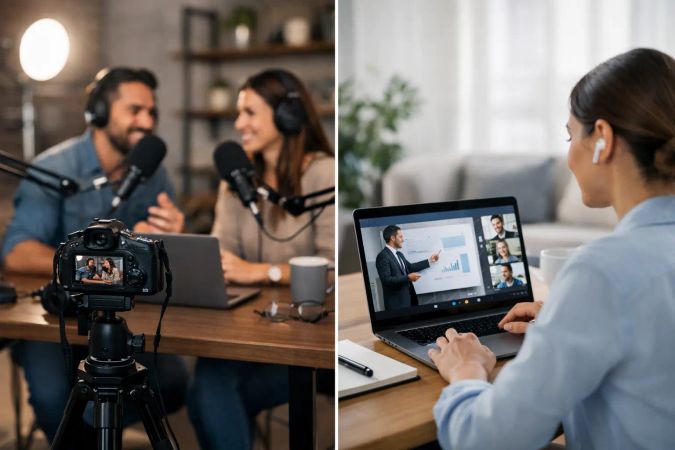
A lot of companies start with the wrong question. They ask whether they should record a webinar because they need leads, or launch a show because video podcasts are popular. The better question is this: in the video podcast vs webinar decision, what job does the content need to do for your business over the next 6 to 12 months?
For professional service firms, B2B companies, and subject-matter-driven brands, format is not just a production choice. It affects discoverability, shelf life, audience trust, and how often your team can realistically show up. A webinar can create urgency. A video podcast can create momentum. Those are not the same asset, and treating them as interchangeable usually leads to uneven results.
Video podcast vs webinar: the core difference
A webinar is typically event-based. It is designed around a scheduled moment, often with registration, a focused topic, and a clear business objective such as lead capture, education, or product consideration. It asks the audience to show up at a specific time or consume a replay that still carries the structure of a live presentation.
A video podcast works differently. It is built for ongoing distribution and repeat visibility. Instead of one campaign moment, it creates a publishing engine. Episodes can be clipped, indexed, repurposed, and surfaced across search and social channels over time. For companies with real expertise to share, that difference matters.
That is why the video podcast vs webinar choice should be tied to business model and content strategy, not trend-following. If your goal is to create a recurring body of authoritative media that supports search, trust, and thought leadership, a video podcast often has more long-term value. If your goal is to move a prospect toward a specific action around a specific topic, a webinar may be the better fit.
When a webinar is the smarter choice
Webinars are strong when timing matters. If your firm is responding to a tax change, legal update, market shift, software release, or operational issue that your clients need explained now, a webinar gives you a focused format with built-in urgency.
That works especially well for industries like accounting, law, logistics, finance, and commercial real estate, where clients often need clear answers tied to current decisions. A good webinar can position your team as credible and responsive because it frames expertise around a timely business problem.
Webinars are also useful when your funnel requires registration. If your sales team wants qualified contacts around a narrow topic, a webinar can serve as a clean conversion point. The audience expects a more structured presentation, and the format naturally supports slides, demos, Q&A, and calls to action.
The trade-off is shelf life. Some webinars stay relevant for months, but many lose value quickly because they are tied to a moment. They also tend to be more formal and less flexible in how they are repurposed. Once the live event is over, the replay may still help, but it often feels like a replay.
Why video podcasts often create stronger long-term ROI
A video podcast is usually the better choice when your business needs sustained authority, not just a single campaign spike. That is where many B2B brands make a strategic leap. Instead of producing one-off content that performs briefly, they build a repeatable media presence.
For executive teams, consultants, attorneys, advisors, and niche operators, a video podcast creates a public record of expertise. It gives prospects a chance to see how you think, not just what you sell. That distinction builds trust faster than polished marketing copy because it feels closer to a real conversation.
It also works better for discoverability. A well-produced video podcast can become multiple search-friendly assets from a single recording. You have the full episode, short clips, quote graphics, transcript-based articles, topic-specific snippets, and social posts. One recording session can support weeks of distribution.
That content architecture matters if your brand is trying to improve visibility in traditional search and emerging AI-driven search experiences. A webinar can contribute to that effort, but a recurring video podcast gives you more indexed surface area and more chances to own relevant conversations in your category.
For many firms, consistency is the deciding factor. A monthly or biweekly video podcast is easier to sustain than a constant calendar of live webinars. It asks less from the audience in the moment and often less from internal teams once a production system is in place.
Audience behavior is different too
One reason the video podcast vs webinar decision gets confused is that both are video. But the audience mindset is not the same.
A webinar audience is leaning in for a specific outcome. They are there to learn a defined topic, evaluate an offer, or get answers to a problem they already recognize. That can produce high-intent engagement, but it also narrows the audience. The registration barrier filters people out by design.
A video podcast audience is often earlier in the trust cycle. They may be researching, comparing, or simply becoming familiar with your perspective. They are not always ready to book a call this week. But they are learning who sounds credible, who explains complexity clearly, and who appears worth paying attention to later.
For many B2B companies, especially those with longer sales cycles, that early trust-building is not a nice extra. It is the work. Buyers in serious industries often watch quietly for a while before reaching out. A video podcast serves that behavior better than a webinar because it is easier to sample, easier to revisit, and easier to discover without commitment.
Production and resource demands
Webinars sound simple because they can be done quickly. Sometimes that is true. But a good webinar still requires planning, promotion, moderation, audience management, and follow-up. If it is live, there is little room for error. If the speaker is not sharp on camera or the structure drifts, the whole event feels weaker.
Video podcasts require a different kind of discipline. The challenge is not live execution. It is editorial consistency. The show needs a clear point of view, repeatable topics, and a production standard that reflects the brand well. That is why many companies benefit from a studio partner rather than trying to piece it together internally.
For businesses in the South Bay and Harbor Area, especially firms that want polished authority without building an in-house video operation, a studio-based workflow can remove a lot of friction. Recording several episodes in a controlled environment is often far more efficient than repeatedly organizing standalone webinar events.
Which format drives better business results?
It depends on what result you mean.
If you measure success by registrations, live attendance, and direct lead capture around a narrow offer, webinars are often stronger. They create a clear conversion event. You can build campaigns around them, route follow-up quickly, and track response to a timely topic.
If you measure success by authority, search visibility, content longevity, and ongoing brand amplification, video podcasts usually have the advantage. They keep working after publication. They make your expertise easier to find. They help your firm look active, informed, and credible in a way that compounds over time.
This is where many growth-minded companies shift their thinking. They stop asking which format gets the fastest win and start asking which format creates a stronger media asset base. In that frame, video podcasts are often the better long-term investment because they serve both audience trust and discoverability.
That does not mean webinars are less valuable. It means they are more situational.
The best answer may not be either-or
Some of the strongest content strategies use both, but not equally.
A smart approach is to treat the video podcast as the foundation and use webinars as strategic campaign events. The podcast builds ongoing authority and searchable media. The webinar creates targeted moments for lead generation, education, or market response.
For example, a commercial real estate firm might use a recurring video podcast to discuss market trends, tenant strategy, and investment considerations throughout the year. Then it could run a webinar when a major financing shift or local market development creates immediate audience demand. The podcast builds visibility. The webinar captures urgency.
That structure works because each format does a distinct job.
How to decide with confidence
If your team has deep expertise but limited time, start with the format you can sustain well. For most firms, that means a video podcast with a clear editorial strategy, strong production, and a distribution plan that turns each episode into multiple usable assets.
If your pipeline depends on event-style education or your audience expects scheduled presentations, add webinars where timing and intent justify them. Do not force a webinar cadence if your real need is consistent authority-building.
For brands that want stronger visibility, trust, and content that keeps paying off, video podcasts tend to offer broader marketing value. That is especially true for businesses selling expertise rather than impulse purchases. A polished, recurring show gives prospects repeated proof that your team knows the space, understands the market, and can communicate with clarity.
A webinar can win attention for a moment. A video podcast can earn relevance over time. If your business is serious about amplification, that difference is worth getting right.