Best Business Podcast Studios for B2B Growth
A business podcast can either become a library of credible, searchable sales assets or a series of expensive conversations that never reach the right buyer. The difference often starts with choosing from the best business podcast studios for your actual commercial goals, not simply the studio with the nicest lights or the lowest hourly rate.
For B2B companies, professional service firms, and established local organizations, a video podcast should do more than document a discussion. It should turn executive insight into clips, articles, social content, search-relevant video, and proof that your company understands the problems prospects are trying to solve. The studio is part of that system, but it is not the whole system.
What the Best Business Podcast Studios Actually Provide
A strong business podcast studio creates an environment where expertise comes through clearly and consistently. That starts with polished video and clean audio, but the real value is confidence and efficiency. Executives should be able to arrive prepared, sit down, and focus on the conversation rather than microphones, camera settings, retakes, or editing logistics.
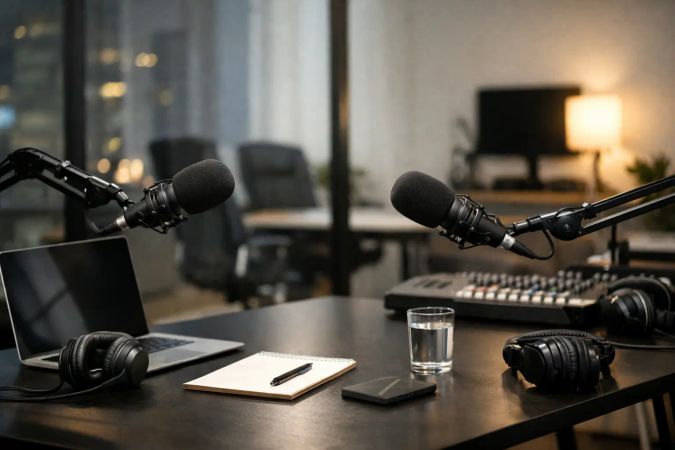
The best facilities are designed for repeatable production. They have professional camera placement, flattering and consistent lighting, acoustically controlled rooms, reliable audio capture, and a visual setup that supports your brand rather than competing with it. A video that looks improvised can weaken a strong message, especially in fields where trust is central to the buying decision, such as law, finance, commercial real estate, logistics, accounting, and technology.
Still, production quality alone does not make a studio the right partner. A visually impressive set can produce content with little marketing value if no one has considered the audience, the subject matter, or how each episode will be used after recording. The right studio understands that the final deliverable is not one long episode. It is a body of business content that can earn attention over time.
Start With the Outcome, Not the Equipment List
Before comparing studios, define what the podcast needs to accomplish. A leadership team focused on recruiting may need a different format than a commercial real estate firm looking to establish market authority or a logistics provider looking to educate prospective customers about complex operations.
For most B2B brands, a video podcast can support several outcomes at once: stronger thought leadership, more visible executive expertise, improved search presence, warmer sales conversations, and a steady source of marketing material. But priorities matter. If lead generation is the main objective, episodes should address real buyer questions, recurring objections, decision criteria, and costly industry mistakes. If reputation is the priority, the format may focus more heavily on informed analysis, client-adjacent insights, and conversations with respected guests.
A capable studio partner asks these questions before discussing camera packages. They should want to know who needs to hear the content, what your audience searches for, what differentiates your expertise, and where the finished material will appear. That early strategy prevents a common failure: producing attractive content that has no clear role in a marketing or sales process.
Evaluate the Studio Through a Video-First Lens
Audio-only podcasts still have value, particularly for audiences that listen during commutes or travel. Yet business leaders should assess studios through a video-first lens. Video creates more opportunities for distribution, improves the usefulness of each recording session, and gives prospects a direct view of the people behind the company.
A well-produced video conversation can be published as a full episode, segmented into short clips, embedded on service pages, included in email campaigns, and used by sales teams after an initial meeting. It can also reinforce the credibility of written content by giving the audience a chance to see an expert explain a complicated issue plainly.
When you tour or evaluate a studio, look beyond whether it has multiple cameras. Ask how the camera angles support natural conversation, whether lighting can be adjusted for different guests and wardrobe choices, and how the set can reflect your company without feeling like a forced advertisement. A generic set may be appropriate for some interview formats. A branded setting may be better for a recurring executive series. The right choice depends on the audience and the level of brand recognition you already have.
Sound deserves the same scrutiny. Poor audio can make viewers leave even when the video looks excellent. Check whether the room is treated for echoes, whether microphones are positioned and monitored by a technician, and whether nearby activity can disrupt recording. Harbor-area businesses, for example, may need a controlled recording environment that separates a meaningful conversation from the practical noise of daily operations.
Look for Strategy Beyond the Recording Session
The studio experience should not end when the cameras stop. The most valuable partners help you build a repeatable content engine around each episode.
That may include pre-production planning, interview outlines, guest preparation, editing for full-length episodes, and the creation of concise clips for distribution. It should also include a practical discussion about titles, topics, descriptions, transcripts, and the search intent behind the content. Search performance is not guaranteed by publishing a video, but content built around specific questions and credible answers has a far better chance of being discovered.
This matters as traditional search and AI-assisted search increasingly surface authoritative explanations. A superficial episode may fill a calendar. A focused episode that explains a real industry issue can continue to attract relevant viewers long after it is published. For professional services, that longevity is often more valuable than a short spike in views.
Voxel Micro Video Labs approaches video podcasts as strategic media assets, particularly for organizations that need their expertise to be visible, understandable, and easy to find. That distinction matters when your audience is not looking for entertainment. They are looking for evidence that your team can solve a serious problem.
Questions to Ask Before You Book
A studio should be able to answer operational questions directly. The answers reveal whether you are hiring a room with equipment or a partner capable of supporting a business program.
Ask how many final assets are included from a typical recording session, how revisions are handled, and whether you will receive usable files for your own marketing team. Confirm who manages audio monitoring, camera operation, editing, and project coordination. If you expect guests, ask how the studio handles scheduling, arrival instructions, comfort, parking, and basic preparation.
You should also ask about consistency. Can the studio recreate the same visual look month after month? Can it accommodate a two-person interview, a panel, or a remote guest when needed? Is there a plan if an executive needs to record several episodes in one session? These details matter because business content usually succeeds through consistency, not a single impressive launch.
Finally, discuss ownership and usage clearly. Your company should understand what it can publish, edit, repurpose, and share across its channels. If the content is intended to generate leads, your sales and marketing teams need practical access to it.
Budget for Consistency, Not Just One Episode
The cheapest option is rarely the least expensive in the long run. A low-cost session may require your internal team to manage preparation, technical issues, editing, clips, publishing, and follow-up. That can drain time from people whose primary job is not media production.
At the same time, a premium studio package is not automatically justified. If your team has not established a clear point of view or cannot commit to a regular publishing cadence, start with a focused pilot. Record several tightly planned episodes, study which topics generate qualified engagement, and refine the format before expanding.
For companies with a clear content strategy, batch recording is often the better investment. Recording three or four episodes in a single session reduces executive time away from the business, creates consistency in the visual presentation, and gives the marketing team a reliable pipeline of material. The objective is not to publish constantly. It is to publish useful content often enough that prospects and search engines can recognize a sustained body of expertise.
A Better Standard for Choosing a Studio
The right podcast studio makes your executives look prepared, sound credible, and spend their time on the message rather than the mechanics. More importantly, it helps connect every recording to a practical business purpose: becoming more discoverable, building authority with the right audience, creating sales-supporting media, and generating better conversations with prospective clients.
Choose the partner that can make your expertise easier to see, hear, find, and trust. When the next buyer searches for answers in your category, your best episode should feel less like content and more like the beginning of a qualified business relationship.