In House Versus Outsourced Video for B2B
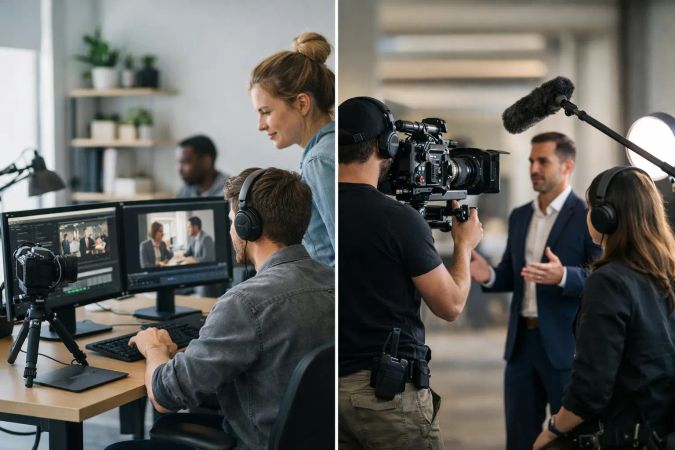
A partner asks a sharp question on camera. Your executive gives a useful, specific answer. That exchange can become a video podcast episode, short clips for LinkedIn, a search-focused article, sales follow-up content, and proof that your company knows its field. The in house versus outsourced video decision determines whether that valuable moment becomes a repeatable business asset or another idea that never makes it past the calendar.
For B2B companies and professional service firms, video is not simply a production question. It is a capacity, credibility, and growth question. The right model should help your organization publish expertise consistently, support search visibility, create stronger sales conversations, and make leadership accessible to the people researching your services.
In House Versus Outsourced Video: Start With the Business Goal
The wrong way to make this decision is to compare a camera purchase with a production quote. Equipment is only one line item. A functioning video program also requires strategic planning, subject-matter preparation, recording, lighting, audio, editing, approvals, distribution, and performance review.
Start with what the content needs to accomplish. A commercial real estate firm may need market commentary that strengthens its reputation with investors and tenants. A law firm may need clear, trust-centered answers to the questions prospective clients ask before making contact. A logistics company may need executive interviews that demonstrate operational knowledge to shippers and supply chain partners.
If the objective is occasional internal communication or quick social updates, an in-house team may be enough. If the objective is recurring thought leadership that supports organic search, sales enablement, and lead generation, the production model needs more structure. Consistency matters because audiences and search systems respond to a steady body of useful, credible content, not isolated videos published when time allows.
What an In-House Video Team Does Well
An in-house model offers proximity. Your team understands the company, knows the people involved, and can often capture timely updates without a long scheduling process. This is particularly useful for internal announcements, product updates, recruiting content, event coverage, and simple social video.
It can also create faster feedback loops. When a marketing coordinator works alongside sales, operations, and leadership, they can recognize emerging topics and turn them into content quickly. For companies with high publishing volume and an established content operation, internal production can become efficient over time.
The trade-off is that video production rarely stays contained within one job description. The person running the camera may also be managing campaigns, updating the website, writing emails, and supporting events. When competing priorities rise, video is often delayed because it appears less urgent than the next immediate request.
There is also a quality threshold to consider. In professional services, finance, technology, and logistics, audiences often judge expertise through presentation as well as substance. Weak audio, unflattering lighting, inconsistent framing, and unfocused interviews can make capable professionals appear less prepared than they are. The issue is not chasing a cinematic look. It is producing media that feels trustworthy enough to represent the business.
The Hidden Cost of Internal Production
Buying cameras, microphones, lights, and editing software is visible. The less visible cost is executive time. A leadership team may spend hours trying to organize a shoot, repeat takes, review rough edits, and solve technical problems that a trained crew handles routinely.
Internal video also requires systems. Someone needs to own the editorial calendar, prepare guests, shape interview questions, organize file storage, create clips, write descriptions, and coordinate publication. Without those systems, a promising in-house setup can produce a burst of activity followed by months of silence.
Where Outsourced Video Creates More Leverage
Outsourced production is most valuable when a company needs an established process rather than another task for its team to manage. A specialist studio partner brings production discipline, but the greater advantage is strategic direction. The best partner helps identify the audience, clarify the message, select formats, and create content that can serve multiple marketing functions.
Video podcast marketing is a strong example. A well-produced business podcast gives an executive a practical format for sharing insight, interviewing clients or industry peers, and discussing relevant market changes. One recording session can generate a full episode, clips, quote graphics, searchable video descriptions, and material for email and sales outreach. It creates a library of expertise instead of a one-time campaign.
For companies in South Bay Los Angeles and the Harbor Area, a studio-based production partner can remove common barriers to consistency. Rather than turning a conference room into a makeshift set, leaders can arrive with a clear topic, record in a polished environment, and leave with content designed for business use. That is especially useful for executives whose knowledge is valuable but whose schedules do not allow for production experiments.
Outsourcing also provides an outside perspective. Internal teams can be too close to their own terminology, processes, and assumptions. A skilled producer asks the questions a prospect would ask, identifies vague language, and helps turn technical knowledge into clear explanations without oversimplifying it.
The Limits of Outsourcing
Outsourcing is not automatically the right answer. A production partner cannot replace internal subject-matter expertise, prompt approvals, or a clear point of contact. If leadership is unwilling to appear on camera, share useful perspective, or commit to a recurring schedule, even excellent production will not build authority.
It can also be inefficient to outsource every small video request. Fast employee updates, short event clips, and casual behind-the-scenes posts may be better handled internally. The key is to avoid asking an external partner to do work your team can execute well and quickly.
The strongest outsourced relationships are collaborative. Your internal team owns business priorities, customer insights, and brand standards. The production partner owns the recording environment, content architecture, interview flow, post-production, and the practical knowledge required to turn each session into a wider content package.
A Hybrid Model Often Delivers the Best Return
For many established B2B firms, the best answer is neither fully in-house nor fully outsourced. It is a hybrid model with clear roles.
Use internal resources for responsive content and day-to-day publishing. Use an external studio for high-value thought leadership, executive video podcasts, customer-facing brand content, and cornerstone videos that need to carry authority across search, social, and sales channels.
This approach protects quality where it matters most while preserving speed for lower-stakes communication. It also gives internal marketers a reliable content engine. Instead of asking, “What should we post this week?” they can repurpose a planned recording session into weeks of relevant material.
A hybrid model works best when every recording has a defined purpose. Before the cameras are on, decide whether the episode is meant to address a buyer concern, explain a service, support a sales initiative, respond to an industry shift, or build a specific area of expertise. That focus keeps video from becoming generic brand awareness content with no measurable business role.
How to Choose the Right Model for Your Team
Consider four practical questions before committing to either path:
- Do you have dedicated internal capacity for planning, filming, editing, and publishing every month?
- Does your audience expect a high level of credibility and production quality before they will engage?
- Can one recording session be repurposed into search, social, email, and sales assets?
- Is leadership willing to show up consistently and share knowledge that helps prospects make better decisions?
If your team has strong internal capacity, a steady publishing rhythm, and content that does not require a controlled production environment, building in-house may make financial sense. If your experts are busy, your industry depends on trust, or your marketing team needs more strategic output from limited time, outsourcing the core production process can create more value.
The answer should not be based on whether a studio feels more polished than a phone camera. It should be based on whether the model helps your company publish useful expertise often enough to earn attention, trust, and qualified conversations.
For businesses that want a more reliable path, Voxel Micro Video Labs can help turn executive insight into video podcast and branded content assets built for visibility, authority, and lead generation. The most effective choice is the one that makes your expertise easier for the right customers to find, understand, and trust.