How Expert Interview Videos Build B2B Authority
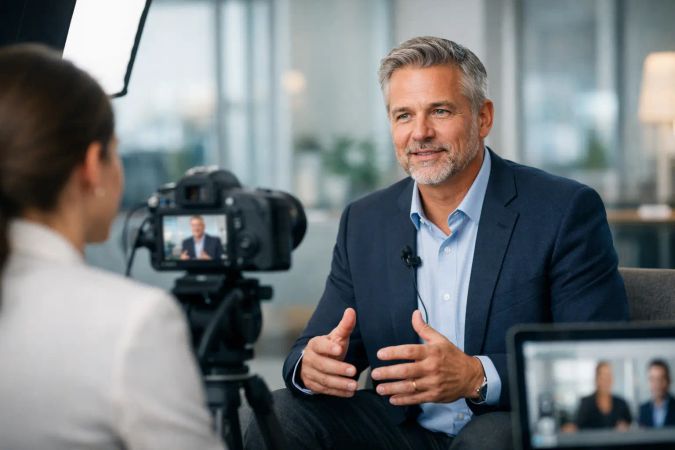
A senior attorney explaining a new compliance risk. A logistics leader clarifying port congestion. A commercial real estate advisor discussing lease decisions. These are not just good conversations. Expert interview videos turn specialized knowledge into a visible business asset - one that can build trust before a prospect ever schedules a call.
For B2B and professional service firms, credibility is often the sale. Buyers want evidence that a company understands their problem, speaks their language, and can provide useful guidance without relying on generic claims. A well-produced interview gives them that evidence in a format that is personal, searchable, and reusable across the marketing system.
Why expert interview videos work for serious industries
Most buyers do not need another polished brand promise. They need confidence in the people behind it. Interview-led video creates room for the judgment, context, and practical perspective that rarely fit on a standard services page.
A tax professional can explain the business impact of a regulation instead of simply stating that the firm offers tax planning. A technology executive can discuss implementation challenges that matter to a cautious operations leader. A shipping company can address a current disruption with the clarity that customers and partners expect from an experienced operator.
This format works especially well because it feels earned. The speaker is not reading a commercial. They are answering relevant questions, explaining trade-offs, and showing how they think. That distinction matters when the audience is considering a high-value, complex, or trust-sensitive purchase.
The strongest interviews also create a library of proof. One focused recording session can produce a full conversation, short social clips, quote graphics, written excerpts, and topic-specific video segments. Instead of treating video as a one-time campaign expense, the business develops an ongoing body of authority that supports sales and marketing over time.
The connection between interviews, search, and video podcasts
Video podcast marketing is more than placing a conversation on a podcast platform. When planned around real buyer questions, it gives a company a repeatable way to publish expertise on a consistent schedule. Each episode can address a defined issue, feature a respected voice, and reinforce the themes the business wants to own in its market.
Search value comes from clarity and specificity. Broad topics such as “business growth” are difficult to own and rarely signal strong intent. A conversation about succession planning for family-owned companies, cybersecurity obligations for local healthcare providers, or warehouse lease strategy near the Port of Los Angeles is more useful to a defined audience. It also gives search engines and AI-driven discovery tools clearer context about the expertise being presented.
The video itself is only part of the asset. A descriptive episode title, a well-written summary, accurate captions, and supporting on-page copy help establish what the conversation covers and who it serves. Short clips can capture individual answers for social distribution, while the full discussion demonstrates depth for buyers who want more than a quick take.
That does not mean every interview should be optimized around a keyword alone. Forced phrasing makes a knowledgeable speaker sound less credible. The better approach is to start with the questions prospects, clients, referral partners, and sales teams repeatedly hear. Search strategy should sharpen the editorial plan, not flatten it.
Choose interview topics that move buyers forward
The best topic is not always the one that sounds most impressive internally. It is the one that helps a prospective client make sense of a decision, risk, or opportunity. That may mean explaining what changed in the market, where companies make costly mistakes, or what a buyer should ask before selecting a provider.
A useful editorial calendar balances timely conversations with evergreen ones. Timely episodes can respond to a new regulation, economic shift, local business development, or industry event. Evergreen episodes can address the fundamentals that buyers research throughout the year. Together, they create both current relevance and long-term discoverability.
For many firms, four types of interview conversations deliver consistent value:
- Client-decision interviews explain how to evaluate a service, prepare for a project, or avoid common mistakes.
- Industry outlook interviews interpret changes that affect the audience, with enough detail to be useful but not so much speculation that the episode expires immediately.
- Process and expertise interviews show how the organization approaches difficult work, including the reasoning behind its recommendations.
- Guest perspective interviews bring in complementary experts, clients, association leaders, or local business voices who add credibility and expand reach.
The guest should have something meaningful to contribute. A recognizable title alone will not carry an episode. Look for people with firsthand experience, a clear point of view, and the ability to explain complex issues without jargon overload. An outside guest can also introduce the brand to a relevant audience, but only when the topic serves both organizations naturally.
Build a conversation, not a filmed interrogation
A strong interview begins before the cameras are on. The host should know the objective of the episode, the audience it is meant to reach, and the one or two ideas viewers should remember. That preparation creates focus without making the exchange sound scripted.
Questions should invite explanation. “What is the biggest mistake companies make when preparing for a lease renewal?” will produce a better answer than “Do companies make mistakes with lease renewals?” Follow-up questions are where credibility often appears. Ask for an example, a decision framework, a warning sign, or the exception to the rule.
It also helps to acknowledge trade-offs. Experienced audiences are skeptical of absolute claims. A financial advisor who says a strategy depends on cash flow, timing, and risk tolerance sounds more credible than one promising a universal answer. Likewise, a technology consultant who explains when a lower-cost option is sufficient demonstrates judgment rather than simply pushing a service.
The host has an important role here. They are not just introducing guests and reading questions. They represent the viewer who needs clear answers. A capable host keeps the discussion moving, translates jargon when needed, and brings the conversation back to business relevance.
Production quality protects the message
An expert can be excellent in person and still appear less credible in a poorly lit, poorly recorded video. Distracting sound, inconsistent framing, and cluttered backgrounds pull attention away from the ideas that should be doing the work.
Professional production does not require a highly stylized set or entertainment-first editing. For professional services and B2B brands, the goal is clean, confident presentation. Good lighting, clear audio, intentional camera angles, brand-consistent visuals, and a comfortable environment allow guests to focus on the conversation.
A studio setting is particularly useful for organizations that want recurring video podcasts without asking executives to manage technical details at the office. It creates visual consistency from episode to episode and reduces the friction that often causes content programs to stall after a few recordings. For South Bay Los Angeles businesses, a dedicated production partner can make regular expert content more practical than building an internal setup from scratch.
Turn each recording into a distribution system
The full interview should have a clear home, but it should not be the only deliverable. Different viewers have different attention levels and discovery habits. An executive may watch a 45-second clip on LinkedIn, while a prospective client researching a complex issue may spend 20 minutes with a full episode.
Plan for distribution before filming. Identify the core episode topic, several short clip themes, and one or two specific calls to action. The call to action should fit the stage of the conversation. An educational episode may invite viewers to explore a related service or schedule a consultation. A guest discussion may encourage viewers to follow the series or submit a question for a future episode.
Do not judge performance only by views. A niche interview for CFOs, property owners, or supply chain leaders may attract fewer viewers than a broad business topic, yet generate more qualified conversations. Watch for the signals that matter: viewing retention, relevant site visits, email responses, sales-team usage, inbound questions, and leads that mention the content.
Consistency matters, but frequency should be realistic. A monthly interview series that maintains a clear point of view is more valuable than a weekly program that runs out of substance or becomes difficult to sustain. The right cadence depends on executive availability, audience demand, and how much content the team can distribute well.
A smart interview series gives your experts a reliable place to show what they know, your buyers a reason to trust you, and your marketing team content with a longer working life. The next useful conversation may already be sitting inside your organization - it simply needs the right questions, a professional setting, and a plan to put it in front of the people who need to hear it.